
Difference Between Internal and External Recruitment: A Complete Guide for 2026

Recruiting the right people is one of the most important factors that decides a company’s success. Whether you’re a fast-growing startup or an established enterprise scaling operations, choosing the right recruitment approach is critical.
Two major hiring approaches used across organisations worldwide are:
Internal recruitment, and
External recruitment
Both methods have their own strengths, limitations, and ideal use cases.
This guide explains what internal and external recruitment really mean, their differences, advantages, disadvantages, and when each approach works best.
If you’re analysing the internal and external recruitment process for your organisation, this article will help you make a clear, confident decision.
What Is Internal Recruitment?
Internal recruitment means filling a vacancy using someone who is already part of your organisation.
This can include:
Promoting an existing employee
Transferring someone to a different department
Rehiring a former employee (boomerang hire)
Considering interns or trainees for a full-time role
Offering internal job postings before announcing them externally
Internal hiring works because the candidate:
Already understands the company culture
Knows workflows and expectations
Has a proven track record
Requires minimal training or onboarding
Common Internal Sources of Recruitment
Promotions
Department transfers
Employee referrals
Re-employment of former employees
Internal job boards / Intranet postings
Succession planning candidates
What Is External Recruitment?
External recruitment means hiring candidates from outside the organisation.
These applicants may bring new skills, new ideas, and industry experience that the existing workforce may not have.
External hiring involves sourcing candidates through:
Job portals
LinkedIn and social networks
Recruitment agencies
Campus hiring
Employee referrals
Industry events, seminars, job fairs
Headhunting / executive search
External hiring expands the company’s talent pool and helps bring diversity, innovation, and specialised skills.
Common External Sources of Recruitment
Online job boards
Recruitment consultants
University / campus hiring
Social media sourcing
Walk-ins
Job advertisements
Talent communities
Freelance platforms
Key Differences Between Internal and External Recruitment
Here is a clear comparison of internal vs external recruitment, covering all major aspects:
Factor | Internal Recruitment | External Recruitment |
Source | Candidates from within the company | Candidates from outside the organisation |
Speed | Fast — employees are already screened and known | Slower — involves full recruitment cycle |
Cost | Low cost (no job ads or agency fees) | Higher cost (advertising, screenings, assessments) |
Training Needed | Minimal, as employee already knows processes | High, due to onboarding and company orientation |
Cultural Fit | Already aligned with company culture | Cultural fit must be evaluated |
Talent Pool | Limited to current employees | Large, diverse talent pool |
Innovation | May lead to repetitive thinking | Brings fresh ideas and perspectives |
Employee Morale | Boosts motivation and retention | May cause dissatisfaction internally if outsiders are hired for senior roles |
Risk Level | Low — performance is known | Higher — new employee fit is uncertain |
Advantages of Internal Recruitment
Internal hiring offers several benefits for companies that need stability and speed:
1. Faster Hiring Process
Employees are already part of the organisation, so you skip sourcing, screening, and background checks.
2. Cost-Effective
No need for job ads, agencies, or paid campaigns. Internal posting is almost free.
3. Boosts Employee Morale
Promotions and cross-functional moves show employees their growth matters.
4. Lower Performance Risk
You already know the candidate’s work ethic, performance history, and behaviour.
5. Shorter Onboarding Time
Internal hires adjust quickly because they understand systems, teams, and company culture.
Advantages of External Recruitment
External recruiting is ideal for expanding your talent pool and encouraging innovation.
1. Access to a Wider Talent Pool
You can attract candidates with specialised expertise unavailable internally.
2. Fresh Ideas & Innovation
New hires bring diverse thinking, updated industry knowledge, and new strategies.
3. Improves Workforce Diversity
Hiring externally ensures demographic and intellectual diversity.
4. Fills Skill Gaps Quickly
Best suited for technical or senior roles requiring niche skills.
5. Drives Organisational Competitiveness
Experienced external candidates can elevate performance standards and competitiveness.
When Should You Use Internal Recruitment?
Internal hiring is ideal when:
✔ You need to fill a position quickly
Internal transitions are the fastest because documentation is minimal.
✔ You want to reduce hiring costs
No external ads or agency commissions needed.
✔ You want to reward or retain high performers
Career growth improves retention and engagement.
✔ You want lower hiring risks
Performance is already documented through appraisals and manager feedback.
When Should You Use External Recruitment?
External hiring is better when:
✔ You need fresh skills or ideas
Particularly important for innovation-driven roles.
✔ Your internal pipeline is limited
Small companies or growing startups often lack internal successors.
✔ You want to improve diversity
External recruiting widens your demographic reach.
✔ You need niche talent
Some roles require specialised experience that may not exist internally.
Best Practices for Balancing Internal and External Recruitment
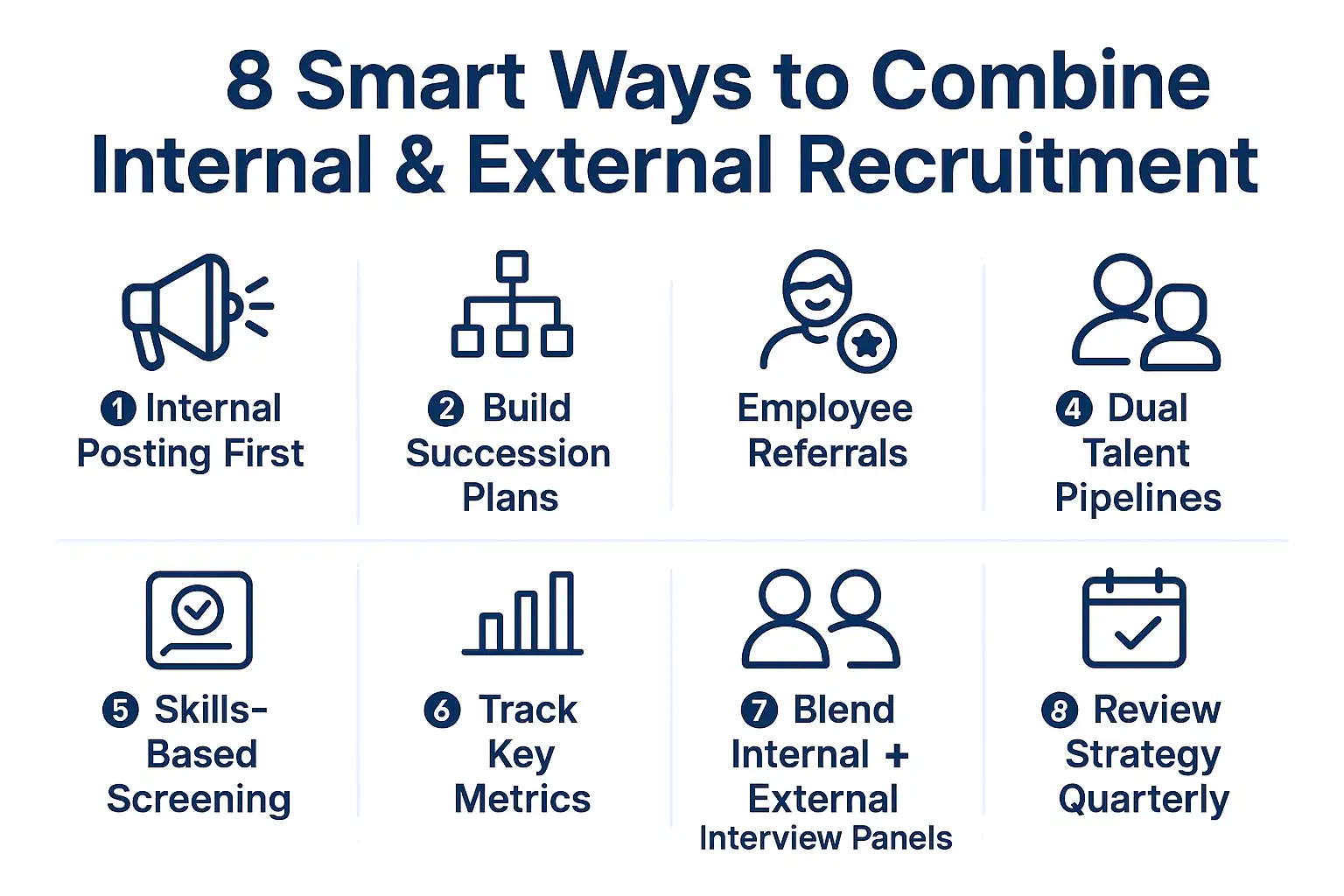
Smart organisations don’t choose one method — they strategically combine both.
Here’s how:
1. Use transparent communication
Clearly share job openings internally before going public.
2. Implement unbiased selection processes
Use structured interviews and skill assessments to avoid bias.
3. Create strong talent development programs
Upskilling internal employees improves internal hiring success.
4. Use employee referral networks
They work amazingly for both internal and external recruitment.
5. Build succession planning frameworks
Identify future leaders early and groom them over time.
6. Track performance metrics
Evaluate whether your internal and external recruitment strategies truly work.
External Recruitment in India: What International Companies Need to Know
For companies based in Australia, the US, or UK that want to build teams in India, external recruitment takes a specific form. You are not filling an internal vacancy — you are sourcing from an entirely different talent market, one with its own salary benchmarks, hiring norms, and compliance requirements.
Why India is a primary external recruitment destination
India produces approximately 1.5 million engineering graduates per year, with deep specialisation in software development, cloud infrastructure, data engineering, and QA. For international companies facing local skill shortages or high salary expectations in their home markets, India offers access to mid-to-senior engineers at 40–60% of equivalent US or Australian salary costs.
English is the primary language of India's professional and technology sector. Remote collaboration with international teams is standard practice for most Indian engineers, particularly in Bangalore, Hyderabad, Pune, and Delhi NCR.
The compliance dimension of external hiring in India
Unlike internal recruitment — where candidates are already on your payroll — external hiring in India from an overseas company requires a compliant employment structure. Foreign companies cannot simply pay an Indian employee a salary directly without creating a legal employment relationship in India.
The two common approaches are:
Employer of Record (EOR): A third-party organisation becomes the legal employer in India on your behalf. The employee works for you operationally; the EOR handles contracts, payroll, PF, ESI, and all statutory compliance. No Indian entity required.
Own entity: You register a Private Limited Company in India (typically 4–6 months, $15,000–$30,000 in setup costs) and employ staff directly. Better suited to companies planning 50+ hires with a long-term India commitment.
Working with India recruitment specialists
For sourcing, international companies typically work with one of three models:
IT recruitment agencies with India market expertise — best for filling specific roles quickly with vetted candidates
Recruitment Process Outsourcing (RPO) — for companies making multiple hires over a sustained period who want a managed pipeline rather than individual placements
Integrated EOR and recruitment services — where the same provider sources the candidate and employs them compliantly, reducing vendor coordination
Learn about SynkPay's IT recruitment services in India →
Or see how RPO works for international companies building India teams →
Internal vs External Recruitment: Which Is Better?
There is no universal winner.
The better approach depends on your company’s:
Hiring urgency
Budget
Skill requirements
Growth stage
Talent availability
Company culture
The strongest organisations use a hybrid approach, leveraging both internal and external recruitment sources depending on the situation.
Conclusion
Understanding the difference between internal and external recruitment helps organisations make better hiring decisions, reduce recruitment costs, and build a strong and future-ready workforce.
Each method has its own advantages, disadvantages, and ideal use cases — and using them strategically ensures long-term organisational success.
Frequently Asked Questions (FAQs)
1. What is the main difference between internal and external recruitment?
Internal recruitment hires from within the company, while external recruitment hires from outside the organisation.
2. Which recruitment method is faster?
Internal recruitment is much faster because candidates are already familiar with the organisation.
3. When should a company use external recruitment?
When searching for niche skills, fresh ideas, a wider talent pool, or improved diversity.
4. Does internal recruitment improve morale?
Yes. Promoting or transferring internal employees boosts engagement and retention.
5. What are internal and external sources of recruitment?
Internal sources include promotions, transfers, referrals, and rehires.
External sources include job portals, agencies, campus hiring, advertisements, and social media sourcing.
6. Is external recruitment more expensive?
Generally yes, since it includes advertising, screening, assessments, and onboarding costs.